
How Large Language Models Actually Work (Without the Math)
What Is a Large Language Model (LLM)?
A Large Language Model (LLM) is an artificial intelligence system trained on vast amounts of text to understand and generate human language.
Unlike traditional software that follows predefined rules, LLMs learn patterns from data. This allows them to:

Answer questions
Write articles and emails
Summarize documents
Generate code
Translate languages
Assist with research and problem-solving

Popular AI tools such as ChatGPT, Microsoft Copilot, Claude, and Gemini are all powered by LLMs.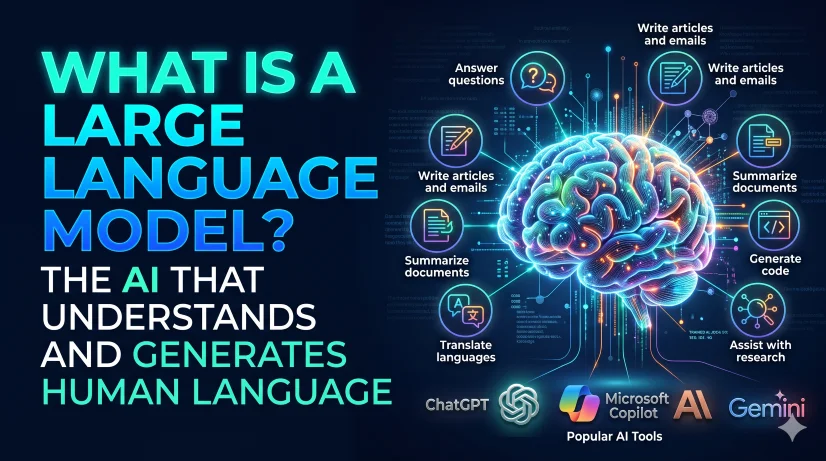
The Core Idea: Predicting the Next Token
At the heart of every LLM is a simple objective:
Predict the next piece of text.
Before processing language, the model breaks text into smaller units called tokens.
A token can be:
A complete word Part of a word A punctuation mark A symbol
For example:
"Artificial Intelligence is transforming businesses."
Might be broken into several smaller tokens that the model can process efficiently.
When you enter a prompt, the model:
Reads all previous tokens. Predicts the most likely next token. Adds that token to the sequence. Repeats the process until a complete response is generated.
Every answer produced by an LLM is created one token at a time.
Why This Matters
Understanding token prediction explains why AI can:
Generate creative content Continue stories naturally Answer questions conversationally Occasionally make mistakes that sound convincing
The model is generating what is statistically likely, not retrieving a guaranteed correct answer.
How Transformers Revolutionized AI
Modern LLMs are built on a deep learning architecture called the Transformer.
Before Transformers, language models often struggled to connect information across long passages of text. They could lose track of context as conversations grew larger.
Transformers changed everything by introducing a mechanism called attention.
This breakthrough significantly improved how AI understands language and context.
What Is Attention and Why Is It Important?
Attention allows an LLM to determine which words and phrases are most relevant when generating the next token.
Consider this question:
What is the capital city of France?
The model learns to focus heavily on:
Capital City France
And less on:
What Is The
This selective focus helps the AI understand relationships between words and concepts.
Benefits of Attention
Because of attention, modern LLMs can:
✅ Understand context more effectively
✅ Follow complex instructions
✅ Maintain conversation flow
✅ Summarize long documents
✅ Generate coherent long-form content
Attention is one of the primary reasons today's AI assistants feel dramatically more capable than earlier chatbots.
How Large Language Models Are Trained
Before an LLM can answer questions, it undergoes extensive training.
During training, the model processes massive collections of text from books, articles, websites, research papers, and other publicly available content.
The model repeatedly performs one task:
Predict the missing or next token.
When its prediction is incorrect, internal parameters are adjusted slightly. This process is repeated billions of times.
Over time, the model begins to learn:
Grammar Sentence structure Writing styles Factual relationships Problem-solving patterns Contextual meaning
Rather than memorizing every sentence, the model identifies patterns that help it generalize to new situations.
Fine-Tuning: Teaching the Model to Be Helpful
A trained model can generate language, but that doesn't automatically make it useful.
To improve quality, developers use a process called fine-tuning.
During fine-tuning, the model learns how to:
Follow instructions Remain helpful Reduce harmful responses Provide better conversational experiences
Many modern AI systems also use Reinforcement Learning from Human Feedback (RLHF).
In RLHF, human reviewers evaluate responses and provide feedback on which answers are most useful.
This extra training helps transform a raw language predictor into an AI assistant capable of assisting users in real-world tasks.
Why AI Sometimes Hallucinates
One of the most misunderstood aspects of LLMs is hallucination.
An AI hallucination occurs when the model generates information that sounds believable but is inaccurate or entirely made up.
Why does this happen?
Because the model's primary goal is still prediction.
It predicts what text is likely to come next, not whether the information is objectively true.
Common Causes of Hallucinations Insufficient context Ambiguous prompts Missing information Complex reasoning tasks Knowledge limitations
This is why fact-checking AI-generated content remains important, especially for:
Healthcare Legal advice Financial decisions Academic work Scientific research
Understanding Context Windows
A common myth is that AI remembers everything.
In reality, every LLM operates within a context window.
A context window is the amount of information the model can consider at one time.
Once the conversation exceeds that limit, older information may become less accessible or drop out entirely.
Effects of Context Limits
You might notice that AI:
Forgets earlier details Misses references from long conversations Produces inconsistencies in long documents
For developers building AI applications, effective context management is often just as important as choosing the right model.
Why Prompt Engineering Matters
The wording of your prompt significantly influences the output.
For example:
Prompt 1
Explain machine learning.
Produces a broad explanation.
Prompt 2
Explain machine learning to a 12-year-old using simple examples and analogies.
Produces a much more targeted response.
Tips for Better Prompts
Be specific about the audience. State the desired format. Include relevant context. Define constraints and objectives. Provide examples when possible.
The better the prompt, the better the outcome.
Strengths of Large Language Models
Modern LLMs excel at:
Content creation Summarization Question answering Programming assistance Brainstorming ideas Language translation Customer support automation
These capabilities make LLMs valuable across industries, from software development to marketing and education.
Limitations of Large Language Models
Despite their impressive abilities, LLMs have limitations.
They can:
Hallucinate facts Reflect biases in training data Misinterpret vague prompts Struggle with highly specialized topics Lose context in lengthy interactions
Understanding these limitations helps users and developers apply AI more responsibly.
Key Takeaways
If you remember only three things about how LLMs work, remember these:
- Tokens Power Everything
Language is broken into tokens, and responses are generated one token at a time.
- Attention Creates Context
Attention helps the model determine which information matters most when generating responses.
- Training and Human Feedback Shape Behavior
Large-scale training teaches language patterns, while fine-tuning and human feedback make models more useful and aligned with user needs.
Conclusion
Large Language Models may seem magical, but their foundation is surprisingly understandable.
They work by predicting tokens, using attention to focus on relevant context, learning patterns from enormous amounts of data, and improving through human feedback.
Understanding these fundamentals helps explain both the strengths and weaknesses of generative AI. More importantly, it enables developers, business leaders, and technology enthusiasts to build smarter applications and use AI more effectively.
As AI continues to evolve, a solid grasp of these concepts will become increasingly valuable for anyone working with modern technology.